
Subject · tested on MEE
Business Associations on the bar exam
Agency, partnerships, LLCs, and corporations, including fiduciary duties and shareholder litigation.
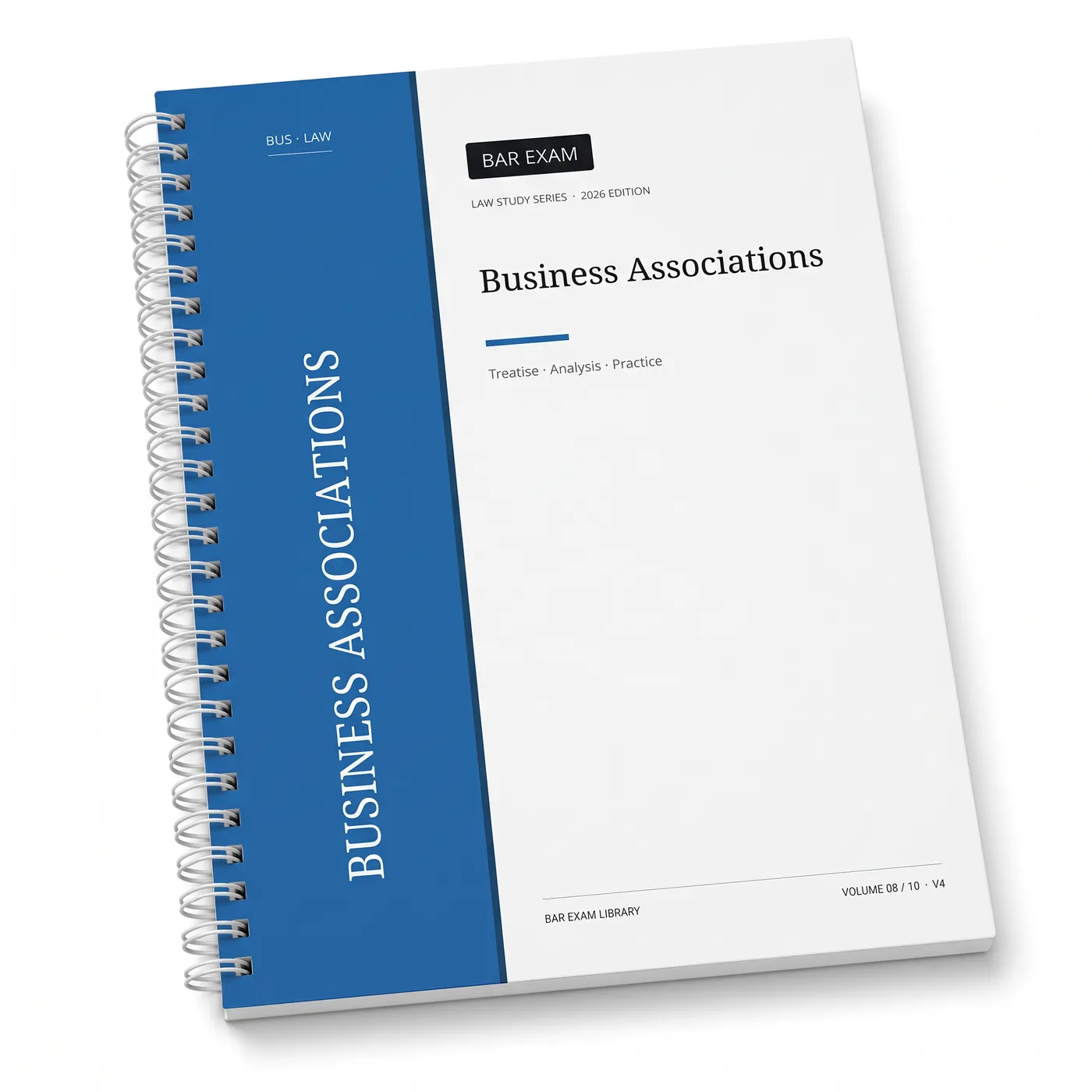
- Pages
- 163
- Chapters
- 19
- Tested on
- MEE
- Single volume
- $29
What Business Associations covers
Business Associations is an essay subject that covers four related bodies of law: agency, partnerships, limited liability companies, and corporations. Questions usually begin with an authority or fiduciary duty problem rather than a formation problem.
The recurring structure is: who acted, did they have authority, whom does that bind, and did they breach a duty in doing so. Answering in that order produces a complete essay even under time pressure.
What examiners test
- Agency authority questions distinguish actual, apparent, and inherent authority, plus ratification.
- Fiduciary duty answers must separate the duty of care, the business judgment rule, and the duty of loyalty.
- Derivative suit questions require the demand requirement and standing analysis.
- Veil piercing and partner liability are frequently tested alongside formation defects.
How to work through the subject
- Study agency first; it is the foundation for partnership and corporate authority questions.
- Keep one page comparing liability and management default rules across entity types.
- Practise full essays rather than multiple-choice questions, since this subject is essay-tested.
Inside the Business Associations volume
163 pages across 19 chapters, organised in the order the law applies:
- Agency formation, authority, and liability
- General partnerships, LPs, and LLPs
- LLC formation, management, and veil piercing
- Corporate formation and promoter liability
- Corporate finance and shareholder voting
- Business judgment rule and duty of loyalty
- Derivative vs. direct suits and demand rules
- Mergers, appraisal rights, Rule 10b-5, and § 16(b)
Frequently asked questions
Is Business Associations on the MBE?
No. It is a Multistate Essay Examination subject, so the preparation goal is written analysis rather than multiple-choice recognition.
Which entity types are tested?
Agency, general and limited partnerships, limited liability companies, and corporations, including fiduciary duties and shareholder litigation.